





August 28, 2026
DR Congo Ebola vaccination live: WHO-backed doses rolled out to frontline health workers
The Democratic Republic of the Congo is trying to slow its fastest-growing Ebola outbreak as vaccination, research, contact tracing and community-led care race against transmission.
What we know
- More than 5,200 Ebola cases have been reported in the Democratic Republic of Congo as of 24 August, about 100 days after the outbreak was declared.
- The outbreak is caused by the Bundibugyo virus, which influences vaccine and treatment approaches.
- Vaccination efforts prioritize frontline and health workers, with 70,000 doses of the Ervebo vaccine allocated: 50,000 for frontline workers and 20,000 for a Phase 3 clinical trial.
- Containment strategies include early detection, contact tracing, access to care, and building community trust.
- WHO is conducting a planned clinical evaluation of candidate vaccines alongside ongoing vaccination activities.
Live updates
Publication times are shown in US Eastern Time and UTC. Event times are stated in the update text when confirmed.
Current official video: Ebola response in the DRC
Watch the WHO Africa video on the current Ebola response in the DRC (published 11 August 2026). We link to the official video instead of re-uploading it: WHO states that reuse of photos and other non-openly licensed materials requires permission.
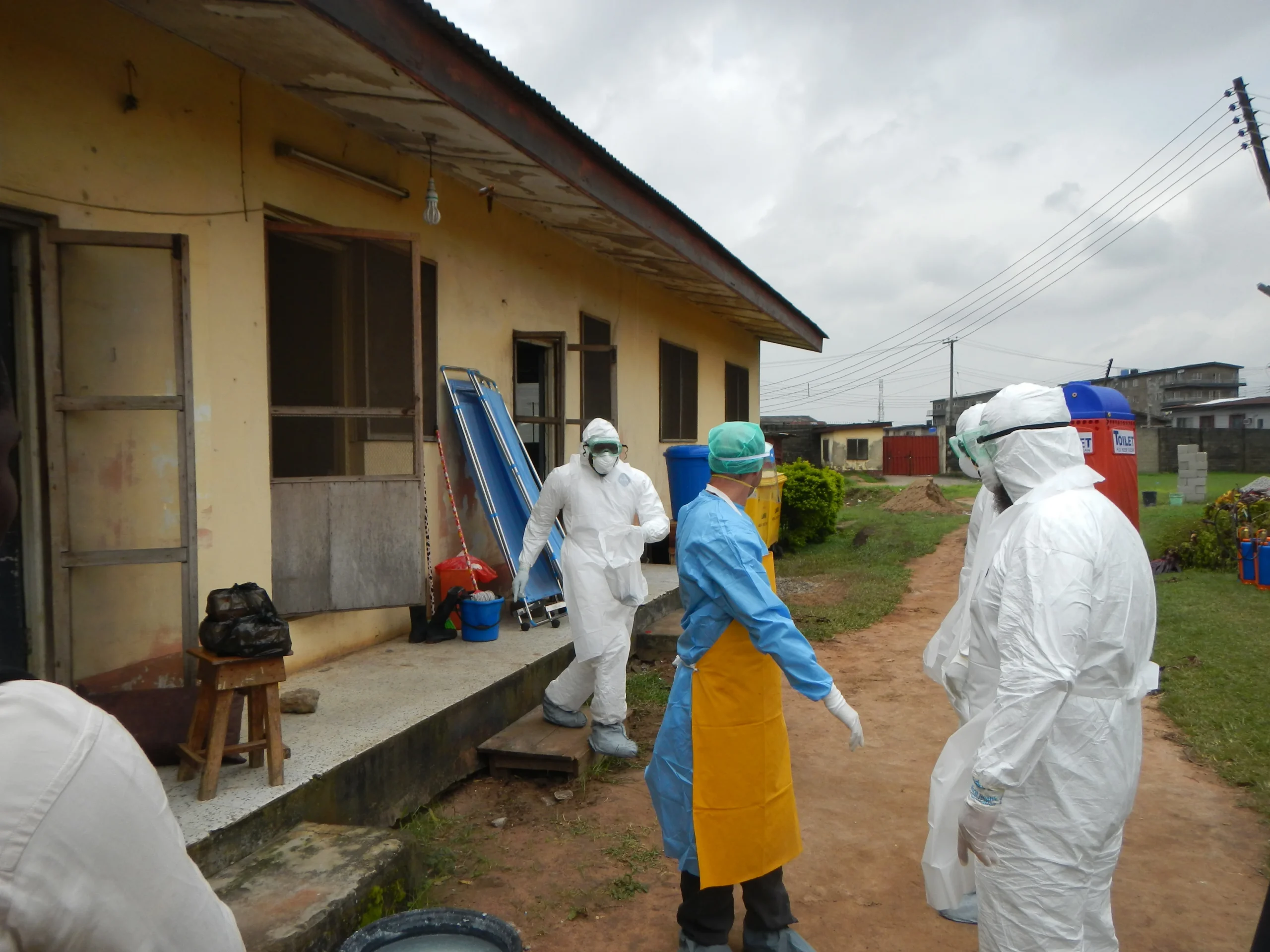
Archival context: health workers using Ebola protective equipment
Archival context image from Lagos, Nigeria (2014); it is not from the current DRC outbreak.
WHO-backed vaccine allocation moves into frontline rollout
DR Congo has begun prioritising frontline and health workers for Ebola vaccination, according to health authorities and international agencies. WHO and Africa CDC say 70,000 Ervebo doses were allocated: 50,000 for frontline and health workers and 20,000 for a Phase 3 trial assessing impact against the Bundibugyo virus.
The agencies say the response also depends on early detection, contact follow-up, access to care and support for affected communities. The campaign is targeted; it does not establish that vaccination is being offered to the wider public.
What we’ll be tracking
Why it matters
DR Congo is prioritizing frontline and health workers for Ebola vaccination with 50,000 doses allocated to this group, highlighting targeted protection efforts.
A total of 70,000 Ervebo vaccine doses have been allocated, including 20,000 for a Phase 3 trial against the Bundibugyo virus, indicating ongoing research alongside response efforts.
The Ebola response relies not only on vaccination but also on early detection, contact follow-up, access to care, and community support, underscoring a multifaceted approach.
Background
Why this Ebola outbreak is different
The Democratic Republic of the Congo is confronting its fastest-growing recorded Ebola outbreak. By 24 August, roughly 100 days after the declaration, the World Health Organization said more than 5,200 cases had been recorded. The outbreak has spread to six provinces, with Ituri accounting for the large majority of reported cases and deaths. These are not just statistics: they describe a response trying to reach people across insecure areas, difficult terrain and health systems already under strain.
The disease in this outbreak is caused by the Bundibugyo virus, one of the viruses that can cause Ebola disease. That detail is essential. “Ebola” is not a single, interchangeable virus, and tools proven against one species cannot automatically be treated as proven against another. WHO says no approved vaccine or specific treatment exists for Bundibugyo virus disease. Researchers and health authorities are therefore pairing established outbreak-control measures with clinical research on vaccines and treatments.
What vaccination does — and does not — mean
Health officials have begun prioritizing frontline workers for vaccination activity, according to reporting from the launch of the campaign. This is an important protective step, but it should not be presented as a finished answer to the outbreak. WHO’s technical advisers have recommended that Ervebo — the licensed vaccine developed for Zaire ebolavirus — be prioritized for evaluation in a randomized clinical trial in the current Bundibugyo outbreak. In other words, the response is using the strongest available options while also gathering the evidence needed to determine how well they work against this virus.
The same careful distinction applies to treatment. WHO says a clinical trial known as PARTNERS began enrolling patients in July and is open at three clinical-management facilities in Ituri. Good supportive care, rapid diagnosis and early referral can save lives, even while investigators work to identify treatments specifically effective against Bundibugyo virus disease.
How Ebola spreads — and how outbreaks are stopped
Bundibugyo virus disease spreads through direct contact with the blood, secretions, organs or other bodily fluids of an infected person, or with contaminated surfaces and materials. People are not infectious before symptoms begin. Early symptoms can resemble many other illnesses — fever, weakness, muscle pain, headache or sore throat — which makes quick laboratory testing and trusted local reporting especially important. More severe illness can follow.
The outbreak-control toolkit is therefore practical rather than mysterious: identify people with symptoms early, test them, isolate and care for confirmed cases, trace contacts, follow those contacts through the incubation period, protect staff with infection-prevention measures, provide safe and dignified burials, and keep essential non-Ebola care functioning. None of these measures succeeds in isolation. A testing site without transport, or a clinic without trust, leaves transmission chains harder to see.
The frontline problem
Health workers are essential to every part of the response and are also exposed to risk. WHO reported at least 155 confirmed infections among health workers and 45 deaths as of 9 August. Clinics outside specialized Ebola treatment centres may have fewer supplies and less established infection-control procedures. At the same time, frontline teams face insecurity, population movement, poor roads, misinformation and heavy workload.
That is why vaccination of priority groups belongs alongside protective equipment, training, fair support, safe transport, laboratory capacity and reliable pay. WHO and Africa CDC have called for these measures to be strengthened, not treated as optional add-ons. Protecting health workers protects patients too: it keeps regular services operating and reduces the risk that a health facility becomes a site of further transmission.
Trust is an operational tool
Community engagement is not merely a communications exercise. Families need information from people they know, clear pathways to care and confidence that seeking help will not put them at greater risk. Local leaders, women’s groups, youth representatives and religious leaders can help identify concerns, challenge misinformation and make response measures workable in daily life. WHO and Africa CDC say response efforts must be led with communities rather than imposed on them.
Contact follow-up shows why this matters. In early August, WHO said only 75% of listed contacts were being followed up daily, below the operational target of at least 95%. Every missed follow-up is a possible delay in detecting a new case. Increasing that rate requires people, communications, transport, data systems and trust — not simply a directive from a capital city.
What the risk means beyond the DRC
WHO assessed the risk within the DRC as very high, and the risk for neighbouring countries sharing land borders with areas of documented Bundibugyo virus transmission as high. The global risk was assessed as low. WHO advises against blanket restrictions on travel or trade with affected countries; it recommends stronger surveillance, laboratory readiness and cross-border coordination instead. This distinction matters because measures that disrupt communities without improving detection can undermine the response they are meant to support.
What to watch next
The decisive indicators are not a single announcement or a single day’s case count. Watch whether new cases are identified earlier, whether contact follow-up improves, whether health facilities remain protected, whether community deaths fall, and whether resources reach the affected areas. Updates on clinical trials and vaccine evaluation will be important, but they should be read alongside the basic response measures that stop transmission now.